The Hub Concept
The "Hub" is the central intelligence of the house, typically located in a Technical Room. It ensures that every sensor node receives both high-speed data and stable power through a single UTP cable, regardless of the distance.
System Architecture Diagram
The diagram below shows the flow from the Power Supply (Hub) to the Sensor Node (Wall).
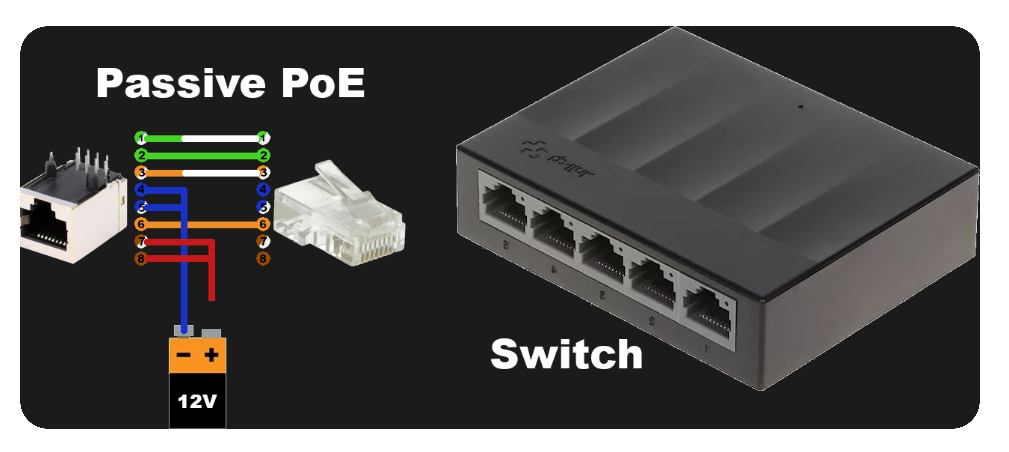
1. Passive PoE Injection
To power the remote nodes, we use the unused pairs in a standard Cat5e/Cat6 cable (Pins 4,5 for Positive and 7,8 for Ground).
- Voltage: 12V DC (Centralized Power Supply).
- Protection: Each line is fused to prevent a short circuit in one junction box from taking down the entire system.
- Distance: This 12V approach allows runs of over 50m because the remote buck converter corrects any voltage drop.
2. Network Management
A central network switch aggregates the ENC28J60 Ethernet streams from all installed sensor modules.
- Reliability: Physical Ethernet avoids the congestion issues of 2.4GHz WiFi in dense residential areas.
- WiFi Repeater Source: This wired link provides the "backhaul" for the WiFi Repeater functionality in the remote nodes.
Remote Power Cycling
One of the primary advantages of this architecture is the ability to hard-reset any remote sensor node from the technical room. By toggling the 12V rail at the hub, you can reboot a frozen Raspberry Pi without opening the wall junction box.
Integration Tip: Connect the 12V injection lines to a multi-channel relay board controlled by a master Home Assistant instance. This allows for automated "Power-Cycle" routines if a node stops responding to pings.